






































































































Mindset Strength in Tennis: Turning Mental Skills Into Action
Motivation Mindset Labs · Applied Mental Skills
Mindset Strength in Tennis: Turning Mental Skills Into Action
A practical look at mindset, purposeful goal setting, and building consistent habits on the court.
Mindset Is a Skill You Can Practice
Tennis asks players to manage emotions, focus on the present point, respond to mistakes, and stay motivated through challenges. The Motivation Mindset Labs approach encourages players to connect meaningful goals with specific, repeatable actions.
This page shares a practical framework and a tennis goal-setting example. It is an educational resource rather than a formal controlled research report.
Mindset Strength Model: Four Quadrants
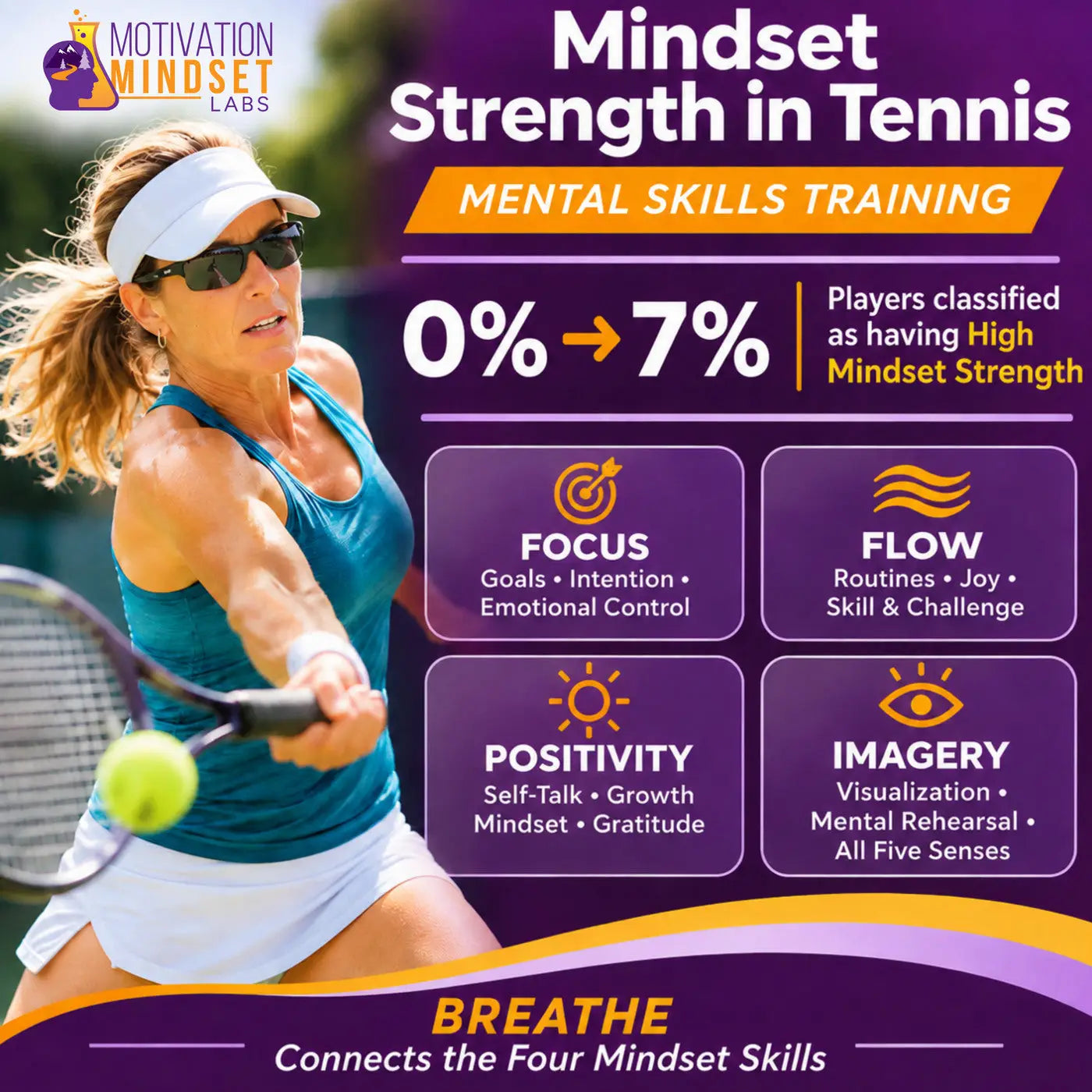
The model organizes mental-skills practices into four areas: FLOW (meditation, rituals, routines, reset, joy, skill/challenge), FOCUS (goal setting, intention, wise effort, emotional control, and responses to mistakes), POSITIVE (self-talk, growth mindset, kind and curious attention, responding rather than reacting, gratitude, and humor), and IMAGERY (recordings, first- and third-person visualization, scripts, and sensory imagery). BREATHE sits at the center, linking a calm, still place with heart-rate control and recovery.

Putting Goals Into Practice: A Tennis Example
The original goal-setting framework distinguishes among performance goals (improvement relative to your own past performance), process goals (actions needed to perform a skill or strategy), and outcome goals (results relative to competitors). Each example identifies whether the goal is short- or long-term and gives a timeframe.

Examples include hitting 80% of volleys properly during the first two weeks (performance), using a unit turn and making contact in front during the first two weeks (process), and aiming to become a state champion by senior year (outcome).
Tennis Season: Mindset Strength Results
0% → 7%
Reached High Mindset Strength
After the tennis season training, 7% of participants were classified as having high mindset strength, compared with 0% before training.
Descriptive Mindset Strength Scale (MSS) results; this comparison alone does not establish causation.
Train the Mind. Master the Moment.
Start with a meaningful goal. Practice one controllable action. Reflect, adjust, and repeat.


